

Berlin Gets Europe's First Synchrotron TES Spectrometer
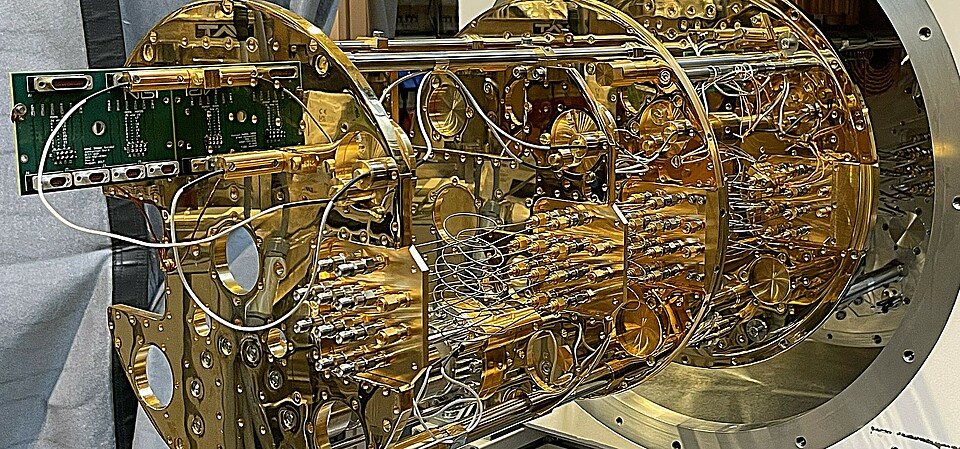
The superconducting sensors need a temperature below 25 milli Kelvin. This is achieved by using a He4-He3 dilution refrigerator, pictured here. It is similar to those used for quantum computers. © Régis Decker / HZB
Berlin's Helmholtz-Zentrum Berlin (HZB) has switched on a one-of-a-kind scientific instrument at its BESSY II synchrotron light source: a superconducting Transition Edge Sensor (TES) array X-ray spectrometer. According to the HZB press release, it is the only such instrument at a synchrotron source in Europe and just the sixth worldwide.
The numbers behind it are striking. Compared to conventional wavelength-dispersive X-ray emission spectrometers, the new system detects photons 100 to 1,000 times more efficiently. That leap in sensitivity matters because techniques like X-ray emission spectroscopy (XES) and Resonant Inelastic X-ray Scattering (RIXS) are notoriously photon-hungry — until now mostly limited to high-concentration bulk samples. The TES spectrometer changes that, making it possible to study atomically thin layers, nanostructures, and highly diluted atomic and molecular samples.
At the heart of the instrument are 248 superconducting sensors, cooled to 25 milli-Kelvin using a dilution refrigerator of the kind also used in quantum computers. When X-rays hit a sample and it emits photons, those photons strike the sensors and cause a tiny temperature spike that briefly breaks the superconducting state — a change detected via Superconducting Quantum Interference Devices (SQUIDs).
The spectrometer is installed at the BESSY II UE52-SGM beamline and connected to a custom ultra-high vacuum sample chamber. Some XES and RIXS measurements that previously took hours can now be completed in minutes. The HZB team developed the instrument in collaboration with the Max Planck Institute for Chemical Energy Conversion (MPI-CEC) in Mühlheim an der Ruhr and the National Institute of Standards and Technology (NIST) in Boulder, Colorado.
"We are looking forward to receiving exciting research proposals from our user community," says responsible scientist Régis Decker.